Stop Loss & Take Profit Calculator
Calculate stock stop-loss and take-profit prices, profit/loss amounts, and risk-reward ratios online. Help investors scientifically set trading levels and manage risk.
Basic Parameters
Take Profit
Stop Loss
Risk-Reward Ratio (R:R)
For every $1 risk, potential gain 3.00
Key Features
Professional tool to manage trading risk scientifically
Risk-Reward Calculation
Automatically calculate risk-reward ratio to evaluate trade value
Real-time Calculation
Instant results with multiple input methods
Flexible Settings
Set stop-loss/take-profit by price, percentage, or amount
Mobile Optimized
Responsive design for trading anywhere
Privacy Protected
All calculations local, no trading data uploaded
Visual Display
Intuitive charts show profit/loss ratio
What is Stop-Loss & Take-Profit?
Stop-loss and take-profit are among the most important risk management strategies in stock trading. Take-profit means selling to lock in gains when the price reaches your target; stop-loss means selling to limit losses when the price drops to a set level.
Why Set Stop-Loss & Take-Profit?
- Risk Control: Prevent losses from expanding, protect capital
- Lock Profits: Avoid giving back gains due to greed
- Disciplined Trading: Plan ahead, avoid emotional decisions
- Strategy Optimization: Evaluate trade value through risk-reward ratio
Risk-Reward Ratio (R:R) is a key metric for measuring trade value. It's generally recommended to aim for a risk-reward ratio of at least 2:1, meaning potential profit is at least twice the potential loss. This tool helps you quickly calculate stop-loss and take-profit levels and evaluate your trade's risk-reward ratio.
FAQ
Common questions about stop-loss and take-profit
How to set reasonable stop-loss and take-profit percentages?
Generally, take-profit is recommended at 10-20%, stop-loss at 3-5%. Specific percentages should be adjusted based on personal risk tolerance, stock volatility, and market conditions. Risk-reward ratio should be 2:1 or above, meaning profit target should be at least twice the risk.
What is Risk-Reward Ratio (R:R)?
Risk-reward ratio is the ratio of potential profit to potential loss. For example, if you're willing to risk $100 and expect to gain $300, the risk-reward ratio is 3:1. Professional traders typically only consider trades with risk-reward ratios of 2:1 or higher.
Will a stop-loss order always execute at the stop price?
Not necessarily. A stop-loss order is a market order that executes at market price when the stop price is hit. During volatile markets or with low liquidity, the actual execution price may be lower than the stop price (slippage). It's recommended to use stop-loss strategies on liquid stocks.
How do stop-loss strategies differ between short-term and long-term trading?
Day Trading: Tight stop-loss around 3-5%, quick in and out.
Swing Trading: Stop-loss at 5-10%, adjusted based on technical levels.
Long-term Investing: Wider stop-loss at 10-20%, focus more on fundamentals. This tool suits all trading timeframes—adjust parameters according to your trading style.
How to set stop-loss based on technical analysis?
Common technical stop-loss levels include: below support levels (stop if support breaks), moving averages (e.g., below 20-day MA), previous lows, Bollinger Band lower band, etc. Technical stops can be combined with this tool's percentage calculations to choose the most appropriate stop level.
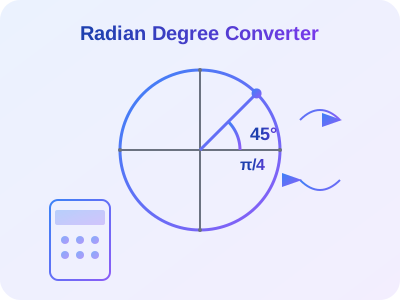
Convert between radians and degrees instantly. Supports π notation, high precision calculations, and real-time conversion. Perfect for students, engineers, and scientists working with trigonometry.

Calculate stock stop-loss and take-profit prices, profit/loss amounts, and risk-reward ratios online. Help investors scientifically set trading levels and manage risk.
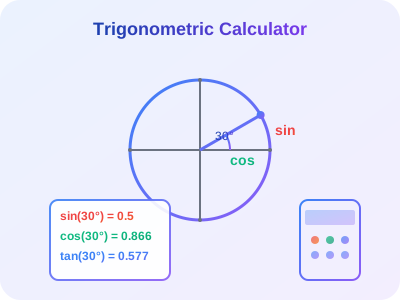
Calculate sine, cosine, tangent, and inverse trigonometric functions. Supports degrees and radians with high precision. Perfect for students, engineers, and mathematicians.